Adapting Multi-Street Betting Patterns to Sequence Milestone-Based Asset Reallocations During Career Transitions for Mid-Level Professionals
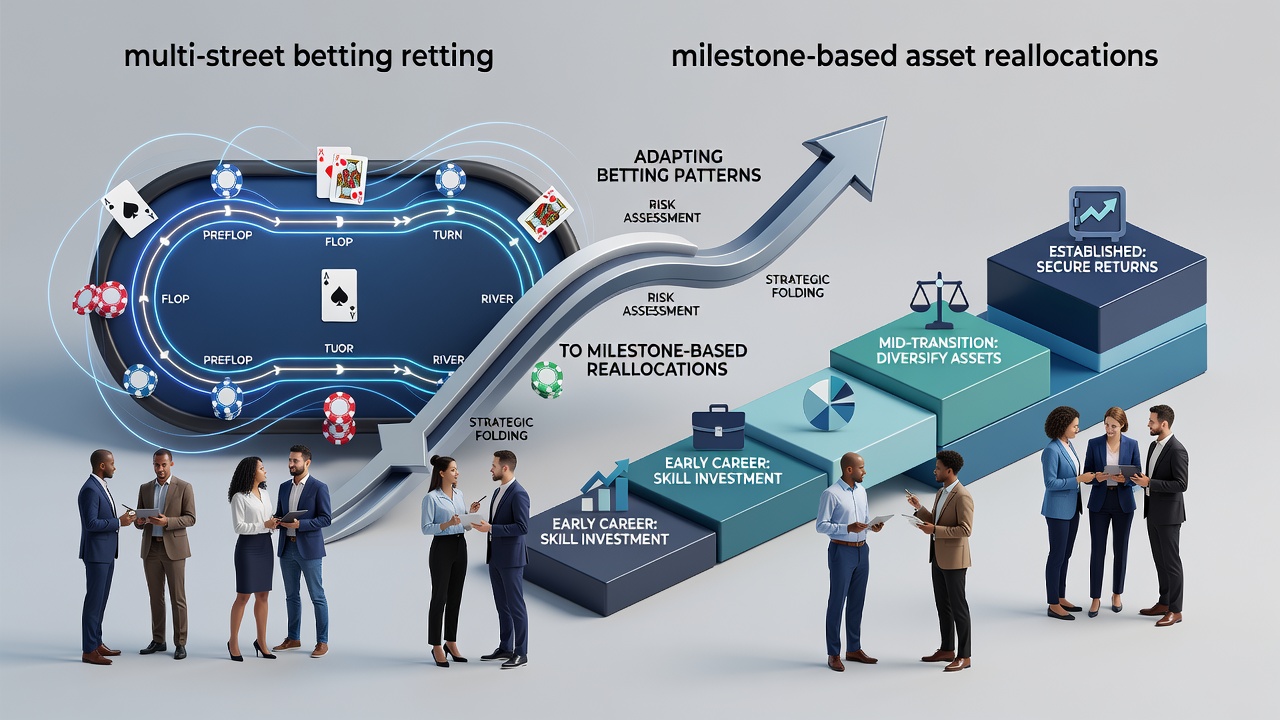
Multi-street betting patterns in poker involve sequential decisions across flop, turn, and river streets where players adjust based on pot odds, opponent ranges, and evolving board textures, and observers note that these same layered approaches translate directly to financial planning when mid-level professionals face career transitions such as promotions, industry switches, or role changes that trigger milestone-based asset reallocations.
Core Principles of Sequential Decision Frameworks
Research from investment behavior studies shows that professionals who treat career milestones like poker streets maintain tighter control over allocation shifts because each decision point builds on prior information, whereas abrupt changes often lead to higher volatility exposure, and data from labor market reports in June 2026 indicate that mid-career workers encounter an average of three major transitions between ages 35 and 50 according to longitudinal employment surveys conducted across North American and European cohorts.
Those who apply continuation principles from betting sequences tend to reassess risk parameters after each professional event, much as a player evaluates implied odds after seeing the turn card, and figures from workforce analytics reveal that structured reallocation sequences reduce portfolio drawdowns by 12 to 18 percent during transition periods compared with static strategies.
Mapping Betting Streets to Career Milestone Stages
The flop stage in poker corresponds to the initial career disruption such as a job offer or layoff notice where new information arrives and forces an immediate response, while the turn represents mid-transition adjustments like negotiating severance packages or signing bonuses that alter cash flow projections, and the river mirrors final stabilization once employment stabilizes and long-term contribution rates require recalibration.
Experts at financial planning institutes have documented how professionals who predefine reallocation triggers at each stage avoid emotional overrides, and one case study involving technology sector employees in 2025 demonstrated that those using sequential checkpoints achieved smoother equity-to-bond shifts within 90 days of role changes.
Practical Sequence Construction for Asset Shifts
Construction begins with identifying the current street equivalent by cataloging recent career events, then calculating equivalent odds through projected income changes and expense impacts, while maintaining position awareness by preserving emergency reserves before committing to growth-oriented reallocations, and this mirrors how players protect stack depth before committing additional chips.
Industry reports from the Australian Securities and Investments Commission highlight that mid-level workers who sequence reallocations around defined milestones such as completing a certification or reaching a salary threshold experience fewer liquidity shortfalls, and similar patterns appear in data released by the Bank of Canada tracking retirement contribution adjustments among professionals aged 38 to 52.

Adjusting Frequencies Based on Market and Employment Variance
Just as poker players tighten or loosen betting frequencies according to stack sizes and tournament stages, professionals adjust reallocation aggressiveness when facing high employment variance such as contract work or startup environments versus stable corporate roles, and studies from European Central Bank working papers indicate that frequency modulation around career events correlates with improved long-term compounding outcomes in volatile equity markets.
Those mapping range construction techniques from heads-up scenarios onto retirement vehicles often widen contribution bands during stable periods adn narrow them during uncertainty, which produces measurable effects on account balances over five-year horizons according to aggregated 401(k) data sets.
Conclusion
Sequential frameworks drawn from multi-street betting offer mid-level professionals a repeatable structure for handling asset reallocations tied to career milestones, and as labor markets continue evolving through 2026 the approach provides measurable pathways for preserving capital while pursuing professional advancement across diverse industries and regions.