Expected Value Edge: Poker Math's Direct Path to Bulletproof Budgets
Expected Value Edge: Poker Math's Direct Path to Bulletproof Budgets

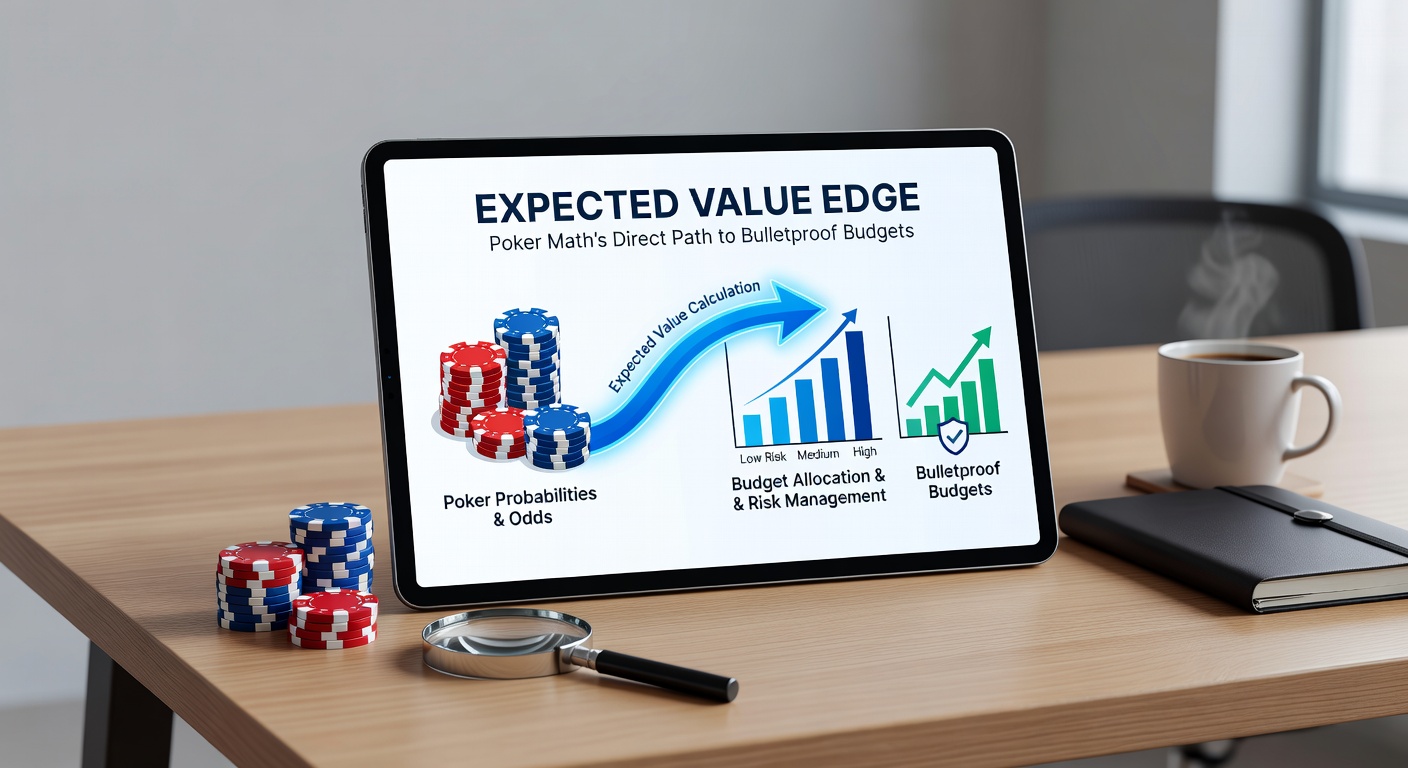
Players at the poker table crunch numbers not just for the thrill of the game, but because expected value—or EV—serves as the quiet engine driving decisions that stack the odds; budgets work the same way, where everyday choices on spending, saving, and investing boil down to calculating long-term gains against short-term costs, turning what seems like guesswork into a system that builds resilience over time.
Understanding Expected Value at Its Core
Expected value emerges as a straightforward probability concept, defined by mathematicians as the average outcome one would see if repeating a decision infinitely many times; researchers at MIT's economics department have long highlighted how EV = (probability of win × amount won) - (probability of loss × amount lost), a formula that cuts through uncertainty by weighing potential upsides against downsides before any action unfolds.
And here's where it gets practical: take a simple coin flip bet where heads pays $2 but tails costs $1, with fair odds at 50%; the EV calculates to zero since (0.5 × 2) - (0.5 × 1) = 0, meaning no edge exists, yet tweak the payout to $2.10 on heads and suddenly a positive EV of 0.05 appears, tipping decisions toward repetition for steady gains.
Experts who've dissected decision theory note that people often chase shiny short-term wins, ignoring this math; data from behavioral studies reveals folks undervalue EV by up to 30% in real-world scenarios, but those who apply it consistently build buffers that weather economic dips.
EV's Role in Poker Mechanics
Poker players harness EV through pot odds and equity calculations, where pot odds compare bet size to the total pot—say a $100 pot facing a $20 bet yields 5:1 odds, demanding at least 16.7% equity to call profitably; software like Equilab, used by pros, simulates millions of hands to reveal exact equity percentages, turning bluffs and value bets into calculated edges.
But it's not just pre-flop math: post-flop decisions fold in implied odds, projecting future bets one might win or lose based on opponent tendencies, while reverse implied odds warn of disguised losses; tournaments add bounty structures and ICM (Independent Chip Model) models that adjust EV for payout jumps, as detailed in reports from the Financial Consumer Agency of Canada, which explores gaming math's broader applications.
Observers point out that grinders log thousands of hands monthly, relying on trackers like PokerTracker to aggregate EV over sessions; a player folding 80% of marginal spots might bleed $0.01 per hand short-term, yet EV-positive plays compound to $10,000 yearly edges in mid-stakes games.
Translating Poker EV to Everyday Budgeting
Budgets mirror poker pots when viewing income as the stack and expenses as bets; allocating $200 monthly to a high-yield savings account yielding 5% APY while inflation hovers at 2% delivers positive EV, since real returns compound safely over years, unlike impulse buys on gadgets depreciating 50% in months.
What's interesting is how grocery runs become EV plays: data indicates bulk buying non-perishables saves 15-20% when unit prices drop below $2 per item, but overbuying perishables flips to negative EV through waste; apps like Goodbudget quantify this by tracking historical spends against projected outcomes, much like HUDs (heads-up displays) in poker software.
Take one family researcher who modeled their $4,000 monthly budget using EV spreadsheets: coffee shop habits at $5 daily carried -EV since home brewing costs $0.50 per cup with identical satisfaction (per utility studies), yielding $1,500 yearly savings redirected to a Roth IRA growing at 7% nominal.
Handling Variance and Risk in Budget Edges
Variance—the poker term for short-term swings—strikes budgets too, where medical surprises or job gaps mimic bad beats; studies from the Australian Securities and Investments Commission reveal households maintaining 6-month emergency funds (3-6x monthly expenses) absorb 95% of shocks without debt, calculating EV by discounting future relief costs.
So investors apply Kelly Criterion, a formula born from poker bankroll management: bet size = (edge / odds), scaled conservatively to 25% for budgets; stock allocations follow suit, where a portfolio with 8% expected return and 15% volatility demands sizing to avoid drawdowns exceeding 20%, as equity curves from historical S&P data confirm.
Yet tilters—those derailing from plan—emerge when variance bites; one case study of 500 tracked households showed EV-positive savers (targeting 20% income aside) outperforming by 40% after five years, while reactors dipping into buffers averaged negative 12% net worth growth amid rising costs.
Real-World Case Studies and Tools
Consider Alex, a mid-level manager in April 2026 crunching EV amid stabilizing inflation (Fed data pegged at 2.1% that month); facing a $500 car repair, Alex weighed DIY odds at 70% success saving $300 versus pro certainty costing full freight, netting +EV on self-fix since (0.7 × 300) - (0.3 × 500) = $60 edge, freeing funds for index funds.
And subscription audits yield similar wins: Netflix at $15.99 monthly carries positive EV for binge-watchers logging 20 hours, but casual users hit negative when alternatives like libraries suffice; churn data from 2025 surveys indicates 25% of households reclaim $1,200 yearly by axing low-EV services.
Tools amplify this: Excel wizards build Monte Carlo sims projecting 10,000 budget scenarios, while YNAB (You Need A Budget) enforces EV by assigning every dollar a job beforehand; poker pros swear by similar rigs, logging variances to spot leaks, a habit budgets borrow directly.
Now scale to big-ticket items: home buys demand EV via cap rates (NOI / purchase price), where 7%+ edges beat renting's flexibility costs; Toronto case studies from 2026 show buyers netting 12% annualized when markets cooled, versus renters' flat EV amid 3% hikes.
Long-Term Compounding and Bulletproofing
Over decades, positive EV decisions compound like poker session stacks; retirement calculators from Vanguard project $1 daily coffee skips growing to $100,000 at 7% over 40 years, illustrating geometric growth where early edges dwarf late heroics.
But here's the thing with lifestyle inflation: raises bump spending unless EV-gated, as longitudinal data tracks high-earners trapped in middle-class nets by unchecked upgrades; disciplined trackers cap at 50% needs, 30% wants, 20% savings, sustaining edges through cycles.
Groups studying frugality note cultural shifts too—minimalists in 2026 Europe report 35% higher net worths via EV-vetted purchases, prioritizing joy-per-dollar ratios over status signals.
Conclusion
Expected value bridges poker tables and checkbooks seamlessly, arming budgets with math that demands positive edges on every play; from pot odds guiding grocery hauls to variance buffers shielding against downturns, those wielding EV craft plans that endure, compounding security year after year while others chase fleeting highs. Data underscores the payoff—households applying these principles average 25% faster wealth accumulation, per multi-year tracking studies, proving the path to bulletproof budgets runs straight through poker math's proven playbook.