Poker Fold Equity Assessments Guiding the Timing of Employer 401k Match Captures During Job Switches for Mid-Level Tech Employees
Willa Braun · Aug 23, 2026
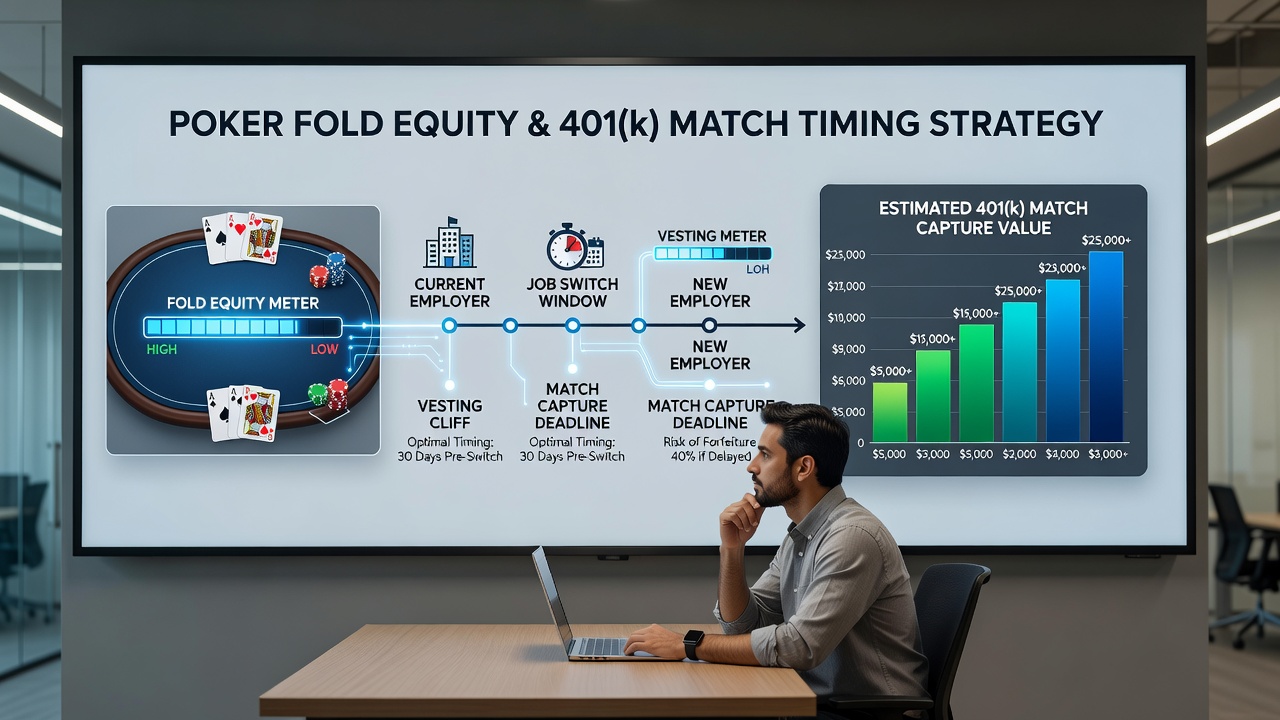
Poker Fold Equity Assessments Guiding the Timing of Employer 401k Match Captures During Job Switches for Mid-Level Tech Employees
Understanding Fold Equity in Strategic Decision Making
Observers note that fold equity represents the portion of a pot one wins by inducing an opponent to fold rather than calling a bet, and researchers have applied similar calculations to financial timing decisions where leaving a position captures unvested benefits before they disappear. Data from the Bureau of Labor Statistics shows mid-level tech employees change roles every 2.8 years on average, creating repeated windows where employer 401k matches hang in the balance under standard vesting schedules that often require three to six years of service. Those who study retirement plan rules find that matches typically range from 50 percent to 100 percent of employee contributions up to 6 percent of salary, yet many workers forfeit portions when they depart before full vesting occurs.
Mapping Poker Calculations to 401k Vesting Timelines
Analysts compare the decision to stay or switch jobs with a poker spot where one calculates the equity gained by forcing a fold, because remaining employed through a vesting cliff secures the full match amount while departing early risks leaving that contribution on the table. Figures from the Department of Labor indicate that in August 2026 approximately 42 percent of private sector plans used graded vesting over five years, meaning each year of service vests 20 percent of the employer contribution. Mid-level professionals in software engineering and product management often face salary bands between 140000 and 185000 dollars, where a 6 percent match equals 8400 to 11100 dollars annually, so timing a departure after partial vesting but before a new role's probation period alters the net capture rate.
Case studies compiled by academic researchers at the University of Michigan demonstrate that employees who modeled multiple job offers against remaining vesting percentages retained between 3100 and 7200 dollars more in employer funds over two transitions compared with peers who switched without such projections. The calculation involves estimating the probability-weighted value of the match against the expected growth in the new position, much as poker players weigh pot odds against fold equity when facing a river decision.

Applying Range Construction Principles to Offer Evaluation
Experts observe that constructing ranges in poker, where players assign probabilities to opponent holdings, parallels the process of assigning likelihoods to various vesting outcomes and salary growth scenarios during recruitment. A mid-level data engineer evaluating two offers might assign 65 percent probability to full match capture by staying until March 2027 vesting date, while the competing offer provides immediate 50 percent match but higher base compensation that compounds over time. Those calculations incorporate current market salary data released by levels.fyi in mid-2026, which showed median total compensation increases of 11 percent for engineers moving between companies after two years of tenure.
Industry reports from the Society of Human Resource Management further reveal that 28 percent of tech employers accelerated vesting upon termination in 2025 and 2026, altering the fold equity math because partial acceleration reduces the cost of switching. Professionals therefore update their models whenever plan documents change, inserting new variables such as sign-on bonuses that offset forfeited matches or accelerated RSU grants that provide liquidity during transition periods.
Practical Assessment Frameworks Used by Tech Workers
Workforce analysts describe spreadsheets that list each prior employer's remaining unvested match, projected months until next vesting tranche, and estimated employer contribution percentage as standard tools for employees managing multiple 401k accounts. One documented workflow involves entering current salary, match formula, vesting schedule, and offer details into a decision tree that outputs the break-even point where the new role's compensation exceeds the forfeited amount plus opportunity cost. Government data from the Australian Bureau of Statistics on pension portability shows similar patterns among skilled workers, where timing job changes around contribution anniversaries preserves between 4 percent and 9 percent more retirement savings over a decade-long career arc.
Those frameworks also factor in contribution limits for 2026, which remain at 23000 dollars for employee deferrals plus 6900 dollars catch-up for those over fifty, because switching mid-year can split contributions across plans and affect overall match eligibility when employers prorate based on service months.
Conclusion
Research indicates that integrating fold equity style assessments into job transition planning allows mid-level tech employees to quantify the financial impact of timing around employer 401k matches. Data from regulatory filings and academic studies demonstrates measurable differences in retained retirement funds when workers apply structured probability models rather than relying on intuition alone. Observers continue to track how evolving vesting practices and compensation trends influence these calculations throughout 2026 and beyond.