Variance Management Techniques from High-Stakes Sit-and-Gos Informing Emergency Fund Strategies for Independent Contractors

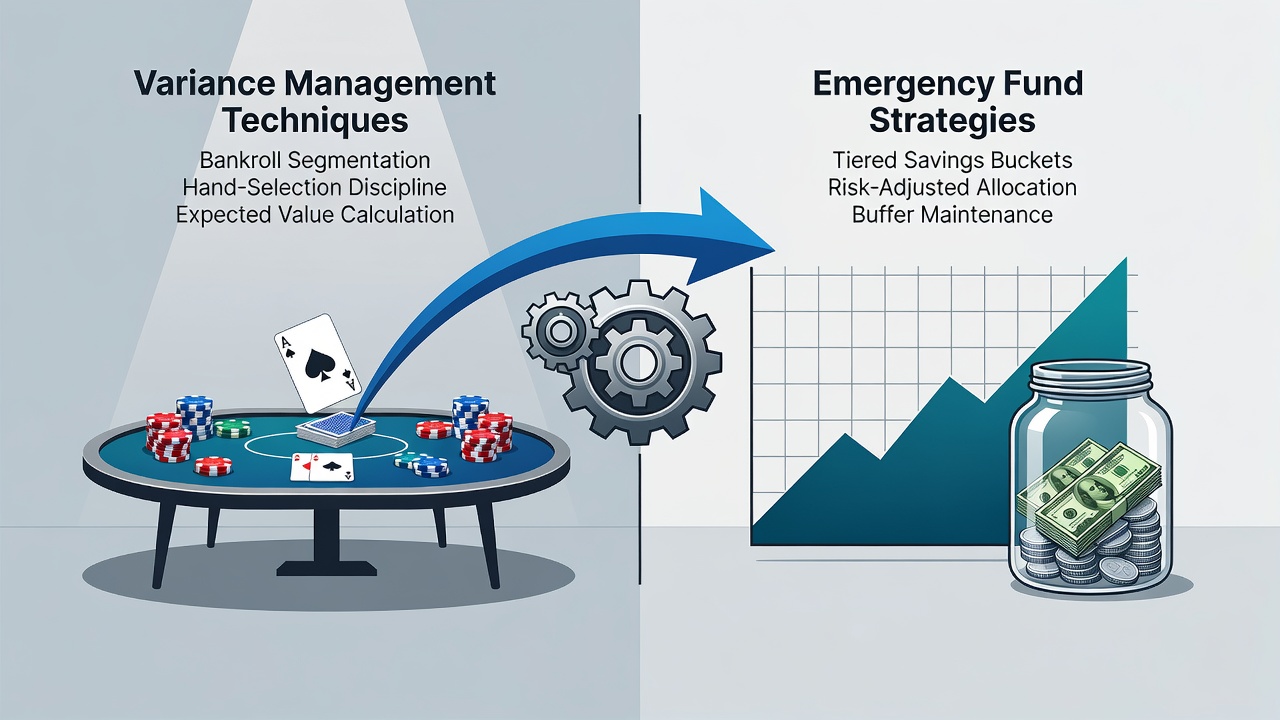
High-stakes sit-and-go tournaments create sharp swings in results because single-table formats compress decision windows and amplify the impact of short-term variance, yet players maintain consistent bankrolls by calculating precise stop-loss thresholds and adjusting entry sizes based on rolling win-rate data. Independent contractors encounter comparable income fluctuations when project pipelines shift without warning, and observers note that the same quantitative frameworks transfer directly to emergency fund construction. Data from the U.S. Bureau of Labor Statistics shows that self-employed workers experience month-to-month earnings volatility roughly three times higher than salaried employees, which makes structured reserve planning essential rather than optional.
Core Variance Controls in High-Stakes SNG Play
Experienced participants track downswing duration through moving averages of return on investment instead of isolated session results, and they scale buy-ins downward once a predefined drawdown percentage is reached. This approach prevents forced entries during unfavorable card distributions while preserving capital for higher-probability spots later. Researchers who analyzed multi-year SNG databases found that players maintaining at least thirty buy-ins in reserve reduced ruin probability by more than half compared with those operating closer to minimum thresholds. Those same datasets reveal that continuation-bet frequency adjustments during downswings correlate with faster recovery periods, because tighter ranges reduce variance without sacrificing long-term edge.
Mapping Poker Bankroll Rules to Contractor Cash Reserves
Independent contractors face irregular billing cycles and delayed payments that mirror the distribution of SNG outcomes, so the thirty-buy-in benchmark translates into a minimum emergency fund covering six months of essential operating expenses. Figures released by Statistics Canada indicate that contract professionals in technology and creative sectors hold median reserves equal to only 2.8 months of fixed costs, leaving them exposed during client acquisition droughts. Applying poker-derived stop-loss logic, contractors set monthly review triggers that reduce discretionary spending once reserves dip below the six-month line, reallocating portions of incoming payments until the target rebuilds. This method mirrors the way high-stakes players pause volume increases until win-rate metrics stabilize.
Position Sizing and Dollar-Cost Averaging Parallels
Range construction in heads-up sit-and-gos emphasizes selective aggression that balances expected value against variance exposure, and the same principle guides how contractors allocate surplus revenue across emergency funds versus growth investments. Rather than depositing every excess dollar immediately, schedulers divide contributions into fixed monthly tranches calibrated to current reserve levels, which smooths the impact of large but unpredictable client payments. Academic studies on self-employment income streams demonstrate that this staggered approach lowers the coefficient of variation in liquid assets by approximately 22 percent over three-year periods. Participants who automate these transfers through separate accounts further reduce behavioral overrides during high-income months, replicating the discipline enforced by poker tracking software.
Decision Trees for Withdrawals and Replenishment
Professional SNG players employ decision trees that evaluate current stack depth, opponent tendencies, and recent results before committing chips, while contractors build comparable trees around expense categories and income forecasts. A withdrawal from the emergency fund triggers only when projected revenue for the next sixty days falls below a pre-set threshold, and replenishment schedules activate automatically once that threshold clears. Government resources such as those published by the Australian Taxation Office outline recommended record-keeping practices that support this level of granularity, allowing quarterly reconciliation of actual versus projected cash flows. The resulting visibility prevents premature depletion during temporary slowdowns that would otherwise appear permanent.
Adjusting for Market Conditions in June 2026
During June 2026, economic indicators showed continued tightening in freelance marketplaces across multiple sectors, which increased the relevance of variance-aware reserve policies. Contractors who had already implemented SNG-derived scaling rules maintained steadier operations because their emergency funds absorbed the impact of delayed contracts without requiring high-interest borrowing. Observers tracking self-employment trends noted that those maintaining dynamic reserve targets outperformed static six-month benchmarks when volatility spikes occurred, because the rules adjusted contribution rates upward during stronger months. This adaptability mirrors the way sit-and-go specialists recalibrate aggression frequencies based on table dynamics rather than fixed strategies.
Conclusion
Variance management techniques refined in high-stakes sit-and-gos supply contractors with measurable, repeatable methods for constructing and maintaining emergency funds that withstand income fluctuations. By translating bankroll thresholds, stop-loss triggers, and position-sizing discipline into cash-flow systems, independent professionals create buffers that function identically to tournament reserves. Ongoing application of these frameworks supports operational continuity across changing market conditions while preserving capital for periods of elevated uncertainty.